
Termite Treatment in Annapolis, MD
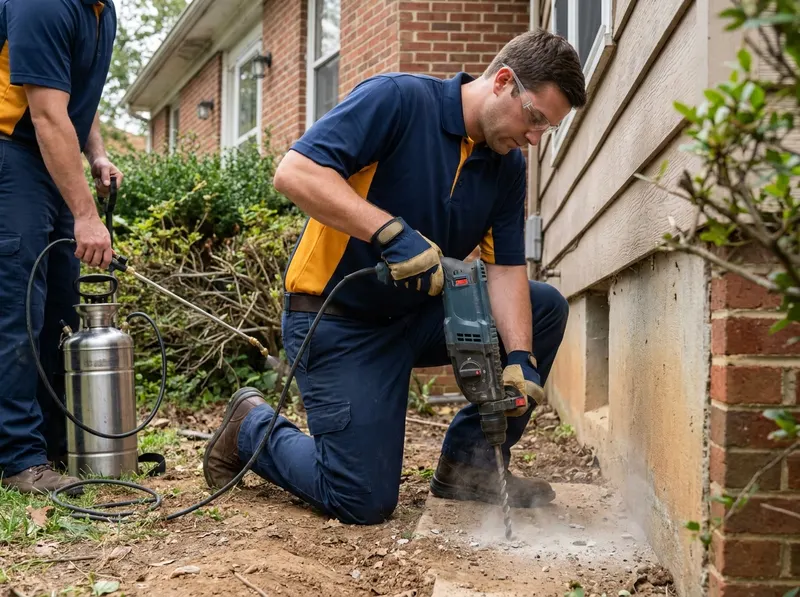
- Included: a full termite inspection of accessible foundation walls, crawlspace, sill plates, and basement, written findings with photos, and a treatment plan naming the exact areas to be trenched, drilled, or baited.
- Speed: inspections are usually scheduled within a few days, and most single-family termite treatments in Annapolis are completed in one visit of four to eight hours.
- Cost: termite work starts at a $250 minimum charge; localized spot treatment typically runs $250-$650, and a full perimeter liquid barrier on an average Annapolis home generally falls in the $1,200-$2,800 range.
- Scope handled: subterranean termite treatment for houses, detached garages, sheds, additions, and crawlspace or slab foundations, including drilling through concrete patios and walkways where termites are tubing up behind them.
- Booking: call (667) 423-1880 to schedule the on-site inspection; the exact price is confirmed in person after we measure linear footage of foundation and see the construction type, not over the phone.
Termite pressure in the mid-Atlantic is constant, and Annapolis adds moisture on top of it. Homes on the water side of Eastport and along the creek edges in Wardour and Annapolis Roads sit on damp, sandy soil that stays wet well after a rain, which keeps termite mud tubes viable right against the foundation. The older housing stock in Murray Hill, Presidents Hill, and West Annapolis often has partial basements, brick foundations with mortar joints, and original sill plates within inches of grade — all normal entry conditions. The 1950s and 60s slab and crawlspace homes in Admiral Heights, Hillsmere Shores, Georgetown East, and Bywater Estates present a different problem: termites travel under the slab and appear at an interior wall, a bath trap, or a garage expansion joint with no visible outside evidence at all. That difference in construction is exactly why we inspect first. Two houses six blocks apart need two different treatments.
The main decision is liquid barrier versus bait system. A **liquid termiticide barrier** means trenching the soil along the foundation, drilling through any concrete that abuts it, and applying a continuous treated zone termites cannot cross without picking up the active ingredient. It works fast, it protects the whole structure, and it is the right call when there is confirmed active feeding — swarmers at the windows in April, mud tubes on a block wall, or hollow-sounding trim. The trade-off is disruption: trenching disturbs beds and mulch, and drilling leaves patched holes in patios and walkways. **In-ground bait stations** are the lower-impact option. Stations go into the soil around the perimeter, termites carry the bait back, and the colony declines over weeks to months. Baits fit tight urban lots where trenching is impractical, properties with hardscape or plantings the owner does not want cut into, and waterfront parcels where minimizing soil-applied volume matters. The trade-off is time and the need for ongoing monitoring — baits are a program, not a one-day fix.
There is also a scope decision. **Spot treatment** is honest and appropriate when activity is limited and clearly bounded — one porch post, one section of sill, an infested shed near Truxtun Park. It is not appropriate when we find tubing in multiple locations or evidence inside a slab, and we will tell you which situation you have rather than sell the cheaper option and leave the colony intact. If you are under contract and a WDI inspection turned up activity, say so when you call; real estate timelines change how we sequence the work and what documentation you need. Annapolis swarm season runs roughly late March through May, usually on the first warm, humid afternoons, and that is when most calls come in — discarded wings on a windowsill are worth an inspection even if you never see a single insect.
What we will not do is guess. **No treatment goes down before we identify what is active and where it is entering**, because a barrier applied to the wrong side of a foundation is money spent on nothing. Termite damage in this area develops over years, so finding it early on a routine inspection is a far better outcome than finding it when a floor joist gives. Call (667) 423-1880 and we will get out, look, and show you what we found.
Call (667) 423-1880Termite Treatment pricing in Annapolis
| Termite inspection with written findings and photos (credited toward treatment) | $250-$350 |
| Localized spot treatment, single confirmed area | $250-$650 |
| Full perimeter liquid termiticide barrier, average Annapolis single-family home | $1,200-$2,800 |
| In-ground bait station system, installation plus first-year monitoring | $1,000-$2,200 |
| Concrete drilling and treatment through patios, walkways, or garage slab | $350-$900 |
| Crawlspace treatment add-on, including sill and pier treatment | $300-$800 |
| Annual renewal, monitoring, and re-inspection | $250-$450 |
| Detached garage or shed treatment | $250-$700 |
Exact price confirmed free on-site before any work.
Termite Treatment — questions, answered
How do I know if I have termites and not carpenter ants in my Annapolis home?
Termites and carpenter ants leave different evidence, and the difference is visible. Termites build mud tubes on foundation walls and leave gallery walls packed with soil; carpenter ants leave clean tunnels and push out coarse sawdust-like frass. Termite swarmers have two equal-length pairs of wings and a straight waist, while ant swarmers have a pinched waist and unequal wings. Annapolis homeowners often find discarded wings on windowsills in April and assume ants — bring them to the inspection and we will identify them on site before any treatment is quoted.
When do termites swarm in Annapolis?
Eastern subterranean termites in Annapolis typically swarm from late March into May, usually on warm, humid afternoons following rain. Swarmers emerging inside a house indicate an established colony already feeding on or under the structure, not a new arrival from outside. Seeing them near a basement window, a slab crack, or a bath trap is the strongest single indicator that a termite inspection is needed that week.
Does a liquid termite barrier work on slab homes in Annapolis neighborhoods like Admiral Heights and Hillsmere Shores?
Yes, liquid barriers work on slab-on-grade homes in Annapolis, but the application is different from a basement home. On slabs we trench the exterior soil and drill through abutting concrete — expansion joints, patios, garage floors, and walkways — to create a continuous treated zone termites cannot bypass. Interior drilling is sometimes required at bath traps or plumbing penetrations where termites are tubing up inside the wall. The inspection determines how much drilling a particular Admiral Heights or Hillsmere Shores slab actually needs.
How much does termite treatment cost in Annapolis?
Termite treatment in Annapolis generally ranges from $250 for a small, bounded spot treatment up to about $2,800 for a full perimeter liquid barrier on an average single-family home, with bait station systems typically falling between $1,000 and $2,200 for installation and first-year monitoring. Price is driven by linear footage of foundation, foundation type, and how much concrete must be drilled. These are ballpark figures for the Annapolis market; the exact price is confirmed on site at the free visit after we measure and see the construction.